Diaryบันทึก日记
Day 81: The Power of Now
Grammar only. The title is unchanged.แก้แต่ไวยากรณ์ ชื่อเรื่องคงเดิม只改语法。标题不动。
This entry is in English only.บันทึกนี้มีแต่ภาษาอังกฤษ此篇仅有英文。
When my father passed away in 2010 — the black swan event of my life — I was left with nothing much for which to live.
I was not just devastated but also purposeless. All I felt was deep depression and that perhaps I could try to end all pain, the same way those who couldn’t handle it anymore usually did. I often couldn’t sleep, and when I could I had a nightmare full of terrifying thoughts, from which I would get up only a few minutes afterwards with a sweaty palms, forehead and back. In fact, I found the writing about one particular moment in the life of Eckhart Tolle resonates directly with how I felt back then:
One night not long after my twenty-ninth birthday, I woke up in the early hours with a feeling of absolute dread. I had woken up with such a feeling many times before, but this time it was more intense than it had ever been. The silence of the night, the vague outlines of the furniture in the dark room, the distant noise of a passing train — everything felt so alien, so hostile, and so utterly meaningless that it created in me a deep loathing of the world.
The most loathsome thing of all, however, was my own existence. What was the point in continuing to live with this burden of misery? Why carry on with this continuous struggle? I could feel that a deep longing for annihilation, for nonexistence, was now becoming much stronger than the instinctive desire to continue to live.
I was about to turn 29 when my father passed away. The state of mind described vividly by Eckhart Tolle in this passage from his book The Power of Now was identical to how I felt back then. Not only did I not want to live, but I also loathed my existence, with the lingering dreadful question “Why me?”

As Nicholas Nassim Taleb writes in The Black Swan, events that have a huge impact on our lives can easily be reasoned backwardly. We human beings tend to do that in order to make sense of it, so that we can continue our existence.
Such a viewpoint is not wrong, but the effect of which is not always positive. In other words, what’s the benefit of telling yourself that you could have prevented what you could not possibly know was coming?
In fact, psychologically, it’s even much more damaging than just to let it go, and accept that we human beings have so many limitations — be it cognitive or physical — so what we can do is to learn from the past so that, perhaps, we can try to avoid making the same mistake.
That said, not all mistakes are the same, and most of the time, as history shows, conditions leading to a particular mistake is never exactly the same. As Taleb uses both the 9/11 attacks and the 2008 financial meltdown as examples of black swans, perhaps we can argue that we have been preventing another one of those from happening using the knowledge we have learned from the past. More close-circuit cameras have been installed in public areas and more regulations against irresponsible investment and potential harmful derivatives have been put in place. But these would only prevent the exact horrors of both events from happening the way they happened. What if they’re taking slightly different forms, based on completely different sets of pre-conditions? So, every mistake is, in fact, a black swan in itself. How can we learn to prevent that from happening?
As I continued to think about my father again during those dreadful suicidal sleepless nights following his departure, I kept rewinding in my head what I could have done.
I could have spent more time with him when he was still alive.
I could have visited him more often when he was still alive.
I could have been a better student so that he would not have to be so worried about me when he was still alive.
I could have been a better son so that he didn’t have to be so stressful when he was still alive.
In fact, I reasoned backward — it would have been nice had I never been born.
Two reasons: He wouldn’t have smoked so much owing to stress (which perpetually had severe impact on his health) had I not born to become a financial burden to our resource-poor family; and that if I had never been born, I would not have to be depressed. All of these were the true feelings that came to me during the time.
Recently, I have been writing a series of posts on design thinking. As I wrote about in my last post, one of the key issues with “thinking” is that we have two systems in the mind: the “hot” and automatic System One that, based on our past experience, wants to make all the decisions quickly; and the “cold” and lazy yet meditative System Two that wants to take into account as much data as it could (like a sage) before making the most optimal decision on our behalf. In the ideal world, we would all preferable prefer System Two, but the only problem is that System Two, as the psychologist Daniel Kahneman writes in Thinking, Fast and Slow, “is lazy and the mental effort is aversive.”
Only after a few months after my father’s death that I had begun to see things differently.
First, my mother was worried because I looked suicidal. She, too, was as sad as I was, if not more, losing the love of her life and her marriage partner for 35 years. My father and mother knew each other before they got married; so, they, in fact, already celebrated their 40th anniversary of their love before my father died. In other words, overshadowing the very fact that I still had my mother was my worries about the past. I did not live in the moment — and that “thinking” almost killed me. Almost a decade after that, I asked myself, was that “backward reasoning” System One or System Two?
Clearly it was not hot and automatic, so it could not be the System One. On the other hand, I failed completely to see a slightly bigger picture — the fact that I still had my mother, my older brother, my extended family members, my caring friends, my colleagues, my teachers and mentors, who did not want to see me in that state of deep depression. Both the psychologists Daniel Kahneman and Amos Tversky have written about the difference between the “experiencing” and the “memorizing” selfs. These are the two selfs that are not the same, and there’re, in fact, many tricks to appeal to the “memorizing self” that a painful and earth-shattering event that we have “experienced” isn’t that bad.
One of the examples frequently use to illustrate this very idea was their experiment with patients undergoing colonoscopy, or (and I resort to a dictionary) “a procedure in which a flexible fiber-optic instrument is inserted through the anus in order to examine the colon.”
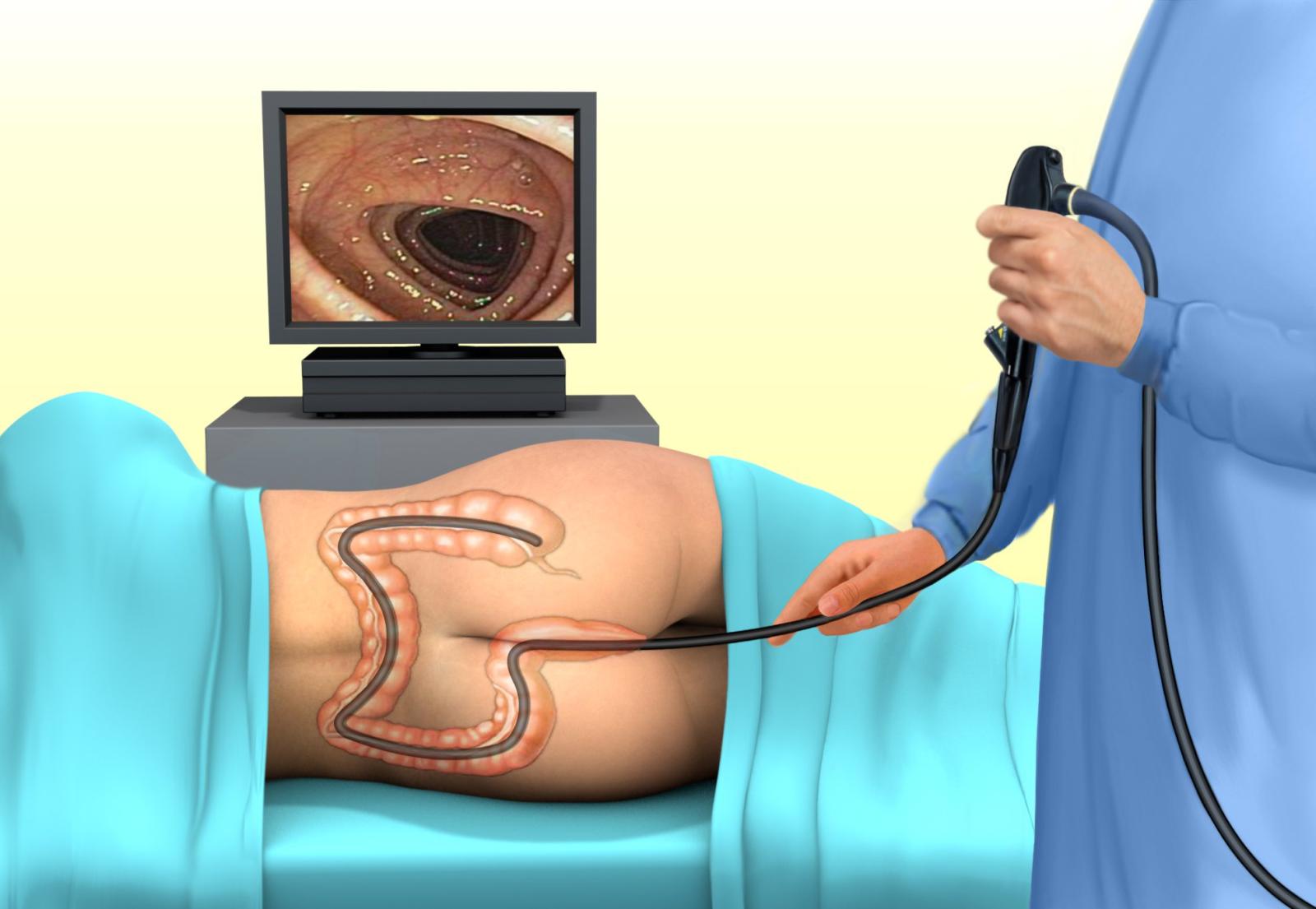
The process, needless to say, was a not a painless process (and since I have never had one myself I could not say much about my “experience” or the “memory” of it). The illustration above might give you some idea of how painful the process could be. Both psychologists were able to show that the group of patients who had gone through a longer operation, which presumably meant that they had to endure more pain, could walk out of the examination room feeling “less painful” about the operation than those who went through a much quicker process. How could that be?
Anchoring the “memorizing self” was what they call the “peak–end rule, ” a mental shortcut in which we judge any particular experience based on how it was felt at its peak. So, since the most painful part of the colonoscopy was the end of the process when the instrument was moving. Leaving the instrument in the bodies of the patients without moving for three extra minutes though yielded an uncomfortable sensation actually did not involve pain; therefore creating a “memory bias” that the overall process was not as painful. To those from whose bodies the instrument was taken out right away after the operation, they reported the process as “painful.” The patients whose operation time was three minutes longer, therefore, tended to remember the process as “not as bad as they though,” compared to those whose “memorizing self” remembered the peak of the pain as the peak end of the process.
So, in this sense, if I try to use this theory to understand my pain toward the departure of my father. What was the peak-end of my father’s death? As I wrote earlier, my father passed away unexpectedly in Thailand, while I was away in the States. I did not have a chance to say good bye. I did not know much about his sickness. In other words, there’s no closure. Would I feel less pain if I had mentally prepared myself for his death? Would I feel that it’s less unexpected? Would I feel that his death was timely, knowing that he had endure the pain for years and this was the right way to go?
In Daniel Lewis account of Daniel Kahneman’s own pain of losing his twenty-one-year-old nephew Ilan who was a navigator in the back of an Israeli fighter during the Yom Kippur war in 1973. There’s a “black swan” kind of incidence during which Ilan could have been killed but he survived the war. But a year and a half later, in March 1975, five days before he was to be released from service, he was killed in a plane crash. Lewis writes in The Undoing Project: A Friendship That Changed Our Minds about Kahneman’s state of mind:
After Ilan’s death, Danny couldn’t help but notice the urge in those who loved him to mentally undo his plane crash. Many of the sentences that came from their lips might just as well have started with the words “if only.” If only Ilan had been released from the Air Force a week earlier. If only he’d taken charge after his pilot was blinded by that flare. People’s minds coped with loss by drifting onto fantasy paths, where loss never occurred. But this drifting, Danny noticed, wasn’t random. There appeared to be constraints on the mind when it created alternatives to reality.
If Ilan had still had a year of service remaining when his plane crashed, no one would have said, “If only he had been released a year ago.” No one said, “If only the pilot had the flu that day” or “If only Ilan’s plane had been grounded for mechanical problems.” For that matter, no one said, “If only Israel had not had an Air Force.” Any of those counterfactuals would have saved his life — but none of them came to the minds of those who loved him.
Again, was this the operation of System One or System Two?
In a black swan incident such as this, the activation of System One would blind us from seeing a bigger picture — that many people also got killed. It’s a war, what do you expect? Anyone going into a war should be prepared to give their life to the service, so should the family members. But in an incidence like this, does thinking about it that way help to ease the pain “memorized” during the unfortunately lack-of-closure peak-end?
What this shows is that we are not all the rational, even with the use of System Two, especially when we are blinded by the force of the memorizing self.
Why should we feel about something according to what we “memorize it” rather than how we “experience it?” That would be like hating someone for what he/she did not do.
A death is a death. It should not matter when a person dies. We will die anyway and there’s no way out of it. So, if we’re to use the hyper-meditated System Two, we should actually be celebrating the passing through of, what the writer Milan Kundera would call, “the unbearable lightness of being.” But we know that’s not how our mind works. In fact, the experience of someone’s dying is not upon us. Surely I wasn’t with my father when he died. I didn’t know his pain. I wasn’t “experiencing” the colonocapic pain with him the way my mother, who had taken care of him during his last months, was probably experiencing. Yet, how come I came to remember his death as untimely which almost drove me to an irreversible act? If only I was there when he died, there would be an “memorizable closure,” and thanks to that I would feel less pain? I asked myself this question. What’s it? A deep regret for not being there for him? A moral backward reasoning?
Then I slipped into the thinking that it would have been painful to everyone around me had I decided to leave this world upon the death of my father. Eckhart Tolle didn’t and he’s now using his experience to help other people through his teaching of what he calls “the power of now.”
Eckhart Tolle argues that most of us are not living — because we do not see ourselves in the “now.” This may sound like an absurd thing to say. What do you mean? Of course I know what the now is, the now is now. I am who I am at the moment. There’s a even a tense to describe that state of being — it’s called the “present tense.” We seem to miss a few points here according to Tolle. Here’re the key point:
First, we “think” too much, so we lose our grip on the “now.” When Tolle himself was depressed during the 29th year of his life, it’s because he thought too much about the past and the future. None of us is perfect and we’re living day by day with our imperfection. The idea of the mistake in the past that keeps expounding upon our present is what drives mad, and, more important, away from the “now.” Often, our memory of the mistakes in the past may not have much to do with the actual experience — remember the difference between the “memorizing” and the “experiencing” self? But when we “think” about something, the memorizing self cabinet is, by default, that which we open in order to recall our memories. Daniel Kahneman calls this psychological effect the “focusing illusion” which is well summarized in his quote:
Nothing in life is as important as you think it is while you are thinking about it.
Think about it. It’s important (while you’re thinking about it).
So, Tolle suggests that actually should not be “thinking,” not fast and not slow — but not thinking at all. As I have shown, even the cold and often-reliable System Two is a victim of our “memorizing self” — and where does that memorizing self come from? It comes from the past.
Now, what about the other devil: the future? Tolle argues that the future is equally problematic.
I recall a famous Zen comic strip by the legendary Taiwanese illustrator Tsai Chih-Chung: The Buddha asks his disciples to guess “how long a person’s life is” — of course, like any Zen’s teaching you could never guess the right answer although whatever it is it would be profound. And the answer is “a person’s life is only as long as the length of our breath.”
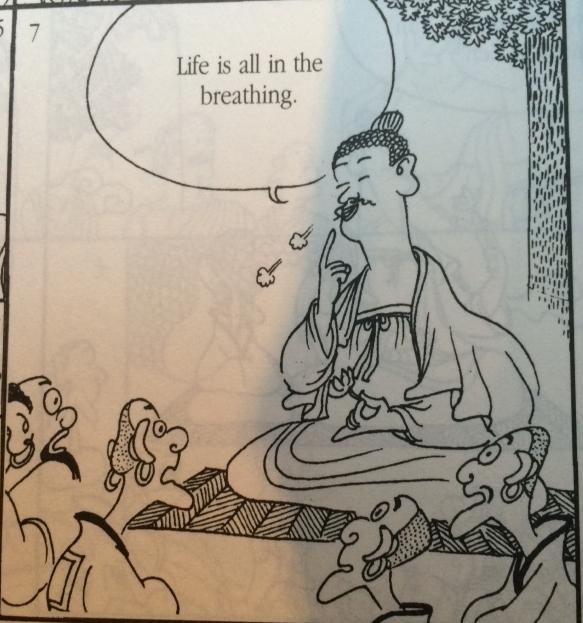
This example resonates with me deeply, especially because that was the true reason for my father’s death. Illness might be the reason why he felt ill, but his chronic lung disease that prevented him from “making that one breath” was what eventually killed him. My father was thinking of coming to visit me in the States once he had gotten better — but that never happened because he could no longer take the one breath at a time he needed to, simply, stay alive. Think about that for a moment.
Tolle suggests that we should systematically “break down” the “now” into its most atomic element.
The “now” is not today, not this hour, not this minute, not this second — and not even this very moment. Let’s not talk about your planned holiday next year, or your dinner with your lover tonight: What if you cannot breathe anymore right now. So, the now resides in the length of our breath. So, a practical advise? (I am not yet there myself but I want to say what I think I want to make it my goal to achieve). Breathe and, while breathing, be thankful for every breath that you and I are still able to take — and just that (and let’t just focus at that for now and forget, also for now, about that every move you make, every bond you break, and every step you take — no one is actually watching you).
As I said, I have not been able to do that fully myself but I believe that which is the best way to activate our System Two to work with our actual “experiencing self” in the now.
Now, was it accidental that, 8 years after my father’s death, I got to inherit Eckhart Tolle’s The Power of Now A Guide to Spiritual Enlightenment from my mother who happened to have just finish reading it and left it in our apartment?
It doesn’t matter. All I want to focus on is my breath.
Unedited original.ต้นฉบับที่ไม่ได้แก้未经修改的原文。
When my father passed away in 2010 — the black swan event of my life — I was left with nothing much for which to live.
I was not just devastated but also purposeless. All I felt was deep depression and that perhaps I could try to end all pain, the same way those who couldn’t handle it anymore usually did. I often couldn’t sleep, and when I could I had a nightmare full of terrifying thoughts, from which I would get up only a few minutes afterwards with a sweaty palms, forehead and back. In fact, I found the writing about one particular moment in the life of Eckhart Tolle resonates directly with how I felt back then:
One night not long after my twenty-ninth birthday, I woke up in the early hours with a feeling of absolute dread. I had woken up with such a feeling many times before, but this time it was more intense than it had ever been. The silence of the night, the vague outlines of the furniture in the dark room, the distant noise of a passing train — everything felt so alien, so hostile, and so utterly meaningless that it created in me a deep loathing of the world.
The most loathsome thing of all, however, was my own existence. What was the point in continuing to live with this burden of misery? Why carry on with this continuous struggle? I could feel that a deep longing for annihilation, for nonexistence, was now becoming much stronger than the instinctive desire to continue to live.
I was about to turn 29 when my father passed away. The state of mind described vividly by Eckhart Tolle in this passage from his book The Power of Now was identical to how I felt back then. Not only did I not want to live, but I also loathed my existence, with the lingering dreadful question “Why me?”
As Nicholas Nassim Taleb writes in The Black Swan, events that have a huge impact on our lives can easily be reasoned backwardly. We human beings tend to do that in order to make sense of it, so that we can continue our existence.
Such a viewpoint is not wrong, but the effect of which is not always positive. In other words, what’s the benefit of telling yourself that you could have prevented what you could not possibly know was coming?
In fact, psychologically, it’s even much more damaging than just to let it go, and accept that we human beings have so many limitations — be it cognitive or physical — so what we can do is to learn from the past so that, perhaps, we can try to avoid making the same mistake.
That said, not all mistakes are the same, and most of the time, as history shows, conditions leading to a particular mistake is never exactly the same. As Taleb uses both the 9/11 attacks and the 2008 financial meltdown as examples of black swans, perhaps we can argue that we have been preventing another one of those from happening using the knowledge we have learned from the past. More close-circuit cameras have been installed in public areas and more regulations against irresponsible investment and potential harmful derivatives have been put in place. But these would only prevent the exact horrors of both events from happening the way they happened. What if they’re taking slightly different forms, based on completely different sets of pre-conditions? So, every mistake is, in fact, a black swan in itself. How can we learn to prevent that from happening?
As I continued to think about my father again during those dreadful suicidal sleepless nights following his departure, I kept rewinding in my head what I could have done.
I could have spent more time with him when he was still alive.
I could have visited him more often when he was still alive.
I could have been a better student so that he would not have to be so worried about me when he was still alive..
I could have been a better son so that he didn’t have to be so stressful when he was still alive.
In fact, I reasoned backward — it would have been nice had I never been born.
Two reasons: He wouldn’t have smoked so much owing to stress (which perpetually had severe impact on his health) had I not born to become a financial burden to our resource-poor family; and that if I had never been born, I would not have to be depressed. All of these were the true feelings that came to me during the time.
Recently, I have been writing a series of posts on design thinking. As I wrote about in my last post, one of the key issues with “thinking” is that we have two systems in the mind: the “hot” and automatic System One that, based on our past experience, wants to make all the decisions quickly; and the “cold” and lazy yet meditative System Two that wants to take into account as much data as it could (like a sage) before making the most optimal decision on our behalf. In the ideal world, we would all preferable prefer System Two, but the only problem is that System Two, as the psychologist Daniel Kahneman writes in Thinking, Fast and Slow, “is lazy and the mental effort is aversive.”
Only after a few months after my father’s death that I had begun to see things differently.
First, my mother was worried because I looked suicidal. She, too, was as sad as I was, if not more, losing the love of her life and her marriage partner for 35 years. My father and mother knew each other before they got married; so, they, in fact, already celebrated their 40th anniversary of their love before my father died. In other words, overshadowing the very fact that I still had my mother was my worries about the past. I did not live in the moment — and that “thinking” almost killed me. Almost a decade after that, I asked myself, was that “backward reasoning” System One or System Two?
Clearly it was not hot and automatic, so it could not be the System One. On the other hand, I failed completely to see a slightly bigger picture — the fact that I still had my mother, my older brother, my extended family members, my caring friends, my colleagues, my teachers and mentors, who did not want to see me in that state of deep depression. Both the psychologists Daniel Kahneman and Amos Tversky have written about the difference between the “experiencing” and the “memorizing” selfs. These are the two selfs that are not the same, and there’re, in fact, many tricks to appeal to the “memorizing self” that a painful and earth-shattering event that we have “experienced” isn’t that bad.
One of the examples frequently use to illustrate this very idea was their experiment with patients undergoing colonoscopy, or (and I resort to a dictionary) “a procedure in which a flexible fiber-optic instrument is inserted through the anus in order to examine the colon.”
The process, needless to say, was a not a painless process (and since I have never had one myself I could not say much about my “experience” or the “memory” of it). The illustration above might give you some idea of how painful the process could be. Both psychologists were able to show that the group of patients who had gone through a longer operation, which presumably meant that they had to endure more pain, could walk out of the examination room feeling “less painful” about the operation than those who went through a much quicker process. How could that be?
Anchoring the “memorizing self” was what they call the “peak–end rule,” a mental shortcut in which we judge any particular experience based on how it was felt at its peak. So, since the most painful part of the colonoscopy was the end of the process when the instrument was moving. Leaving the instrument in the bodies of the patients without moving for three extra minutes though yielded an uncomfortable sensation actually did not involve pain; therefore creating a “memory bias” that the overall process was not as painful. To those from whose bodies the instrument was taken out right away after the operation, they reported the process as “painful.” The patients whose operation time was three minutes longer, therefore, tended to remember the process as “not as bad as they though,” compared to those whose “memorizing self” remembered the peak of the pain as the peak end of the process.
So, in this sense, if I try to use this theory to understand my pain toward the departure of my father. What was the peak-end of my father’s death? As I wrote earlier, my father passed away unexpectedly in Thailand, while I was away in the States. I did not have a chance to say good bye. I did not know much about his sickness. In other words, there’s no closure. Would I feel less pain if I had mentally prepared myself for his death? Would I feel that it’s less unexpected? Would I feel that his death was timely, knowing that he had endure the pain for years and this was the right way to go?
In Daniel Lewis account of Daniel Kahneman’s own pain of losing his twenty-one-year-old nephew Ilan who was a navigator in the back of an Israeli fighter during the Yom Kippur war in 1973. There’s a “black swan” kind of incidence during which Ilan could have been killed but he survived the war. But a year and a half later, in March 1975, five days before he was to be released from service, he was killed in a plane crash. Lewis writes in The Undoing Project: A Friendship That Changed Our Minds about Kahneman’s state of mind:
After Ilan’s death, Danny couldn’t help but notice the urge in those who loved him to mentally undo his plane crash. Many of the sentences that came from their lips might just as well have started with the words “if only.” If only Ilan had been released from the Air Force a week earlier. If only he’d taken charge after his pilot was blinded by that flare. People’s minds coped with loss by drifting onto fantasy paths, where loss never occurred. But this drifting, Danny noticed, wasn’t random. There appeared to be constraints on the mind when it created alternatives to reality.
If Ilan had still had a year of service remaining when his plane crashed, no one would have said, “If only he had been released a year ago.” No one said, “If only the pilot had the flu that day” or “If only Ilan’s plane had been grounded for mechanical problems.” For that matter, no one said, “If only Israel had not had an Air Force.” Any of those counterfactuals would have saved his life — but none of them came to the minds of those who loved him.
Again, was this the operation of System One or System Two?
In a black swan incident such as this, the activation of System One would blind us from seeing a bigger picture — that many people also got killed. It’s a war, what do you expect? Anyone going into a war should be prepared to give their life to the service, so should the family members. But in an incidence like this, does thinking about it that way help to ease the pain “memorized” during the unfortunately lack-of-closure peak-end?
What this shows is that we are not all the rational, even with the use of System Two, especially when we are blinded by the force of the memorizing self.
Why should we feel about something according to what we “memorize it” rather than how we “experience it?” That would be like hating someone for what he/she did not do.
A death is a death. It should not matter when a person dies. We will die anyway and there’s no way out of it. So, if we’re to use the hyper-meditated System Two, we should actually be celebrating the passing through of, what the writer Milan Kundera would call, “the unbearable lightness of being.” But we know that’s not how our mind works. In fact, the experience of someone’s dying is not upon us. Surely I wasn’t with my father when he died. I didn’t know his pain. I wasn’t “experiencing” the colonocapic pain with him the way my mother, who had taken care of him during his last months, was probably experiencing. Yet, how come I came to remember his death as untimely which almost drove me to an irreversible act? If only I was there when he died, there would be an “memorizable closure,” and thanks to that I would feel less pain? I asked myself this question. What’s it? A deep regret for not being there for him? A moral backward reasoning?
Then I slipped into the thinking that it would have been painful to everyone around me had I decided to leave this world upon the death of my father. Eckhart Tolle didn’t and he’s now using his experience to help other people through his teaching of what he calls “the power of now.”
Eckhart Tolle argues that most of us are not living — because we do not see ourselves in the “now.” This may sound like an absurd thing to say. What do you mean? Of course I know what the now is, the now is now. I am who I am at the moment. There’s a even a tense to describe that state of being — it’s called the “present tense.” We seem to miss a few points here according to Tolle. Here’re the key point:
First, we “think” too much, so we lose our grip on the “now.” When Tolle himself was depressed during the 29th year of his life, it’s because he thought too much about the past and the future. None of us is perfect and we’re living day by day with our imperfection. The idea of the mistake in the past that keeps expounding upon our present is what drives mad, and, more important, away from the “now.” Often, our memory of the mistakes in the past may not have much to do with the actual experience — remember the difference between the “memorizing” and the “experiencing” self? But when we “think” about something, the memorizing self cabinet is, by default, that which we open in order to recall our memories. Daniel Kahneman calls this psychological effect the “focusing illusion” which is well summarized in his quote:
Nothing in life is as important as you think it is while you are thinking about it.
Think about it. It’s important (while you’re thinking about it).
So, Tolle suggests that actually should not be “thinking,” not fast and not slow — but not thinking at all. As I have shown, even the cold and often-reliable System Two is a victim of our “memorizing self” — and where does that memorizing self come from? It comes from the past.
Now, what about the other devil: the future? Tolle argues that the future is equally problematic.
I recall a famous Zen comic strip by the legendary Taiwanese illustrator Tsai Chih-Chung: The Buddha asks his disciples to guess “how long a person’s life is” — of course, like any Zen’s teaching you could never guess the right answer although whatever it is it would be profound. And the answer is “a person’s life is only as long as the length of our breath.”
This example resonates with me deeply, especially because that was the true reason for my father’s death. Illness might be the reason why he felt ill, but his chronic lung disease that prevented him from “making that one breath” was what eventually killed him. My father was thinking of coming to visit me in the States once he had gotten better — but that never happened because he could no longer take the one breath at a time he needed to, simply, stay alive. Think about that for a moment.
Tolle suggests that we should systematically “break down” the “now” into its most atomic element.
The “now” is not today, not this hour, not this minute, not this second — and not even this very moment. Let’s not talk about your planned holiday next year, or your dinner with your lover tonight: What if you cannot breathe anymore right now. So, the now resides in the length of our breath. So, a practical advise? (I am not yet there myself but I want to say what I think I want to make it my goal to achieve). Breathe and, while breathing, be thankful for every breath that you and I are still able to take — and just that (and let’t just focus at that for now and forget, also for now, about that every move you make, every bond you break, and every step you take — no one is actually watching you).
As I said, I have not been able to do that fully myself but I believe that which is the best way to activate our System Two to work with our actual “experiencing self” in the now.
Now, was it accidental that, 8 years after my father’s death, I got to inherit Eckhart Tolle’s The Power of Now A Guide to Spiritual Enlightenment from my mother who happened to have just finish reading it and left it in our apartment?
It doesn’t matter. All I want to focus on is my breath.